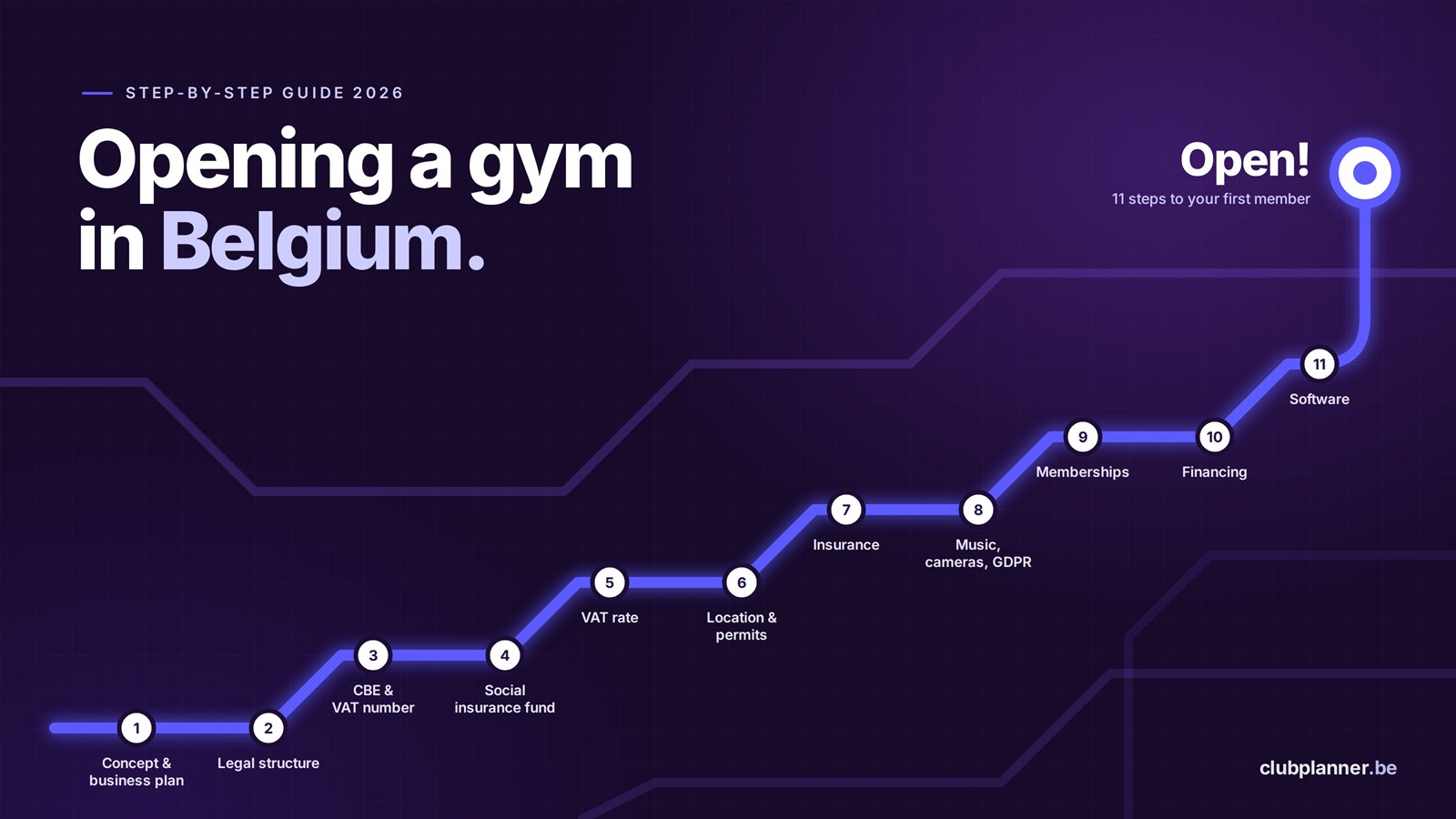
If you want to open a fitness club in Belgium, what you mostly find online are Dutch step-by-step plans. They talk about the Dutch Chamber of Commerce, Dutch VAT and Dutch legal forms. Useful for Eindhoven, useless for Eeklo. This article is the Belgian version: what you actually have to arrange in 2026, in what order, and where starters most often get it wrong.
In short: registering with the Crossroads Bank for Enterprises costs 111.50 euros, a BV, a Belgian private limited company, no longer has a minimum capital requirement but does need a credible financial plan, your memberships normally fall under 6% VAT (the announced increase to 12% has not been implemented as of February 2026), and your contracts already have to comply today with the FPS Economy rules on automatic renewal. From 1 May 2027 a mandatory reminder will be added on top of that. Step by step.
Opening a club does not start with the Crossroads Bank for Enterprises but with a spreadsheet. What kind of club will it be: a budget club with 24/7 access and few staff, a boutique studio with group classes, a personal training studio or a neighbourhood club with everything in it? Every model has a different cost profile, different pricing and, as you will see in step 5, possibly a different VAT rate.
Run your concept through three questions: how many members do you need to break even, how many months of losses can you carry until you get there, and how much of your turnover comes from memberships versus one-off sales? A club that runs on monthly memberships alone is vulnerable in summer and in December.
For the market context we refer you to our earlier article on the Belgian fitness market in figures.
Most club operators go for a BV, the Belgian private limited company. Since the new Code of Companies and Associations there is no longer a minimum capital requirement: "Contributing a minimum amount of capital is no longer a requirement." What does remain is sufficient initial assets, backed up by a financial plan. And that is not a formality. If your company goes bankrupt within three years and the initial assets were manifestly insufficient for at least two years of normal operation, you can be held jointly and severally liable as a founder for the debts (article 5:16 CCA).
For a fitness club, where equipment, refurbishment and the rental deposit add up fast, the financial plan is therefore your real start-up capital. Have it drawn up by an accountant who knows the sector, with a realistic monthly intake of members and a churn rate that is not plucked out of thin air.
A sole trader is possible too, but then you are liable with your private assets for rental and leasing contracts. For a club we advise against it.
Every business has to be registered with the Crossroads Bank for Enterprises (CBE). That is done through a recognised one-stop business shop, a business counter (Xerius, Acerta, Liantis, Securex, Partena and others). According to VLAIO, registering with a business counter costs 111.50 euros. For the activation of your VAT number, counters charge a fee of their own; ask what their rate is.
Use the right activity code (fitness centres have their own NACE code, your business counter knows them) and add your secondary activities: sale of food and drink, personal training, letting out space. An activity that is not listed in the CBE will cause discussion later, during an inspection or with a damage claim.
Good news for starters: the certificate of basic business management has disappeared throughout Belgium. In Flanders since 1 September 2018, in Brussels since 15 January 2024 and in Wallonia since 1 October 2025. Nobody asks for a diploma to run a club any more. Which also means your competitors can start just as quickly as you can.
As a self-employed person in a main occupation you pay social security contributions of 20.5% on your net taxable income. In your first years you pay provisional contributions; for 2026 the minimum contribution in a main occupation is 917.58 euros per quarter. Build that into your financial plan, including in the months when you are not yet paying yourself a salary. Earning nothing does not mean paying nothing.
This is the step that causes the most uncertainty, and rightly so, because the rules have shifted twice in recent years.
The basic rule: granting access to and use of a sports facility falls under the reduced rate of 6%. Following the ruling of the European Court of Justice in case C-330/21 (The Escape Center, 22 September 2022), the tax authorities adjusted their position in circular 2022/C/118 of 21 December 2022. Since then, 6% also applies when your members receive personal guidance or group classes, provided that this guidance is ancillary to the use of the infrastructure. In concrete terms: your members must also be able to train independently outside class hours.
Turn it around and the rate changes. Fitness.be sums it up like this: "only personal training studios and group classes no longer fall under the reduced VAT rate." If you only grant access during supervised sessions, you are at 21%. For a PT studio or a pure boutique studio with classes only, that is a substantial difference in pricing compared with the club round the corner.
Then there is the increase to 12%. On 23 December 2025 the Council of Ministers approved a draft royal decree containing "the increase of the VAT rate from 6% to 12% for services granting the right of access to cultural, sporting or entertainment facilities". The sports sector protested loudly. On 13 February 2026 the federal government decided "not to go ahead with the VAT increase for sport, culture and takeaway meals", with the caveat that the file would be looked at again after the spring half-term break. When the VAT reform partially came into force on 1 March 2026, the reduced rate of 6% for access to sports facilities was therefore maintained.
State of play on 28 September 2026: 6% for access to your club, 21% for pure guidance, and the increase to 12% has not been implemented for now but is not definitively off the table. We found no later decision that actually changes the rate. Build your prices so that a jump from 6 to 12% does not break your margin, and state in your terms that a statutory VAT change will be passed on.
A fitness club is a facility open to the public. Check with your municipality which environmental permit is required for the change of use or the refurbishment of your premises, and have the fire service inspect your gym before you open. Escape routes, capacity, emergency lighting, extinguishers: arrange that before you sign a lease. Premises that cannot be brought up to fire safety standards are not a bargain, however low the rent.
Also think about legionella management in the showers, noise standards during group classes and the municipality's parking standard. That last one is a bigger obstacle for many clubs than the permit itself.
Three policies are non-negotiable. Objective liability insurance for fire and explosion is a legal requirement for the facilities listed in the Royal Decree of 28 February 1991, and sports halls are on that list; the mayor checks whether you have that policy. Public liability insurance covers damage to third parties: a member who slips in the changing room, a machine that topples over. And workplace accident insurance is mandatory from your first employee onwards, including the student who staffs the desk on Saturdays. If you work with self-employed coaches, ask for their own public liability certificate.
Music in your gym and during classes requires a licence from Unisono, with a separate "Sport & Ontspanning" rate guide for 2026. Apply for it before you open, not after the first inspection.
Cameras fall under the camera act: notification to the police, a pictogram at the entrance, never in changing rooms or showers. And your member database is personal data: under the GDPR you need a record of processing activities, a privacy statement and a data processing agreement with your software supplier. Health data from intake questionnaires is a special category; do not keep it in a stray Excel file on the front desk computer.
This is where most new clubs go wrong, and this is where the Economic Inspectorate actually checks. The rules that apply today:
Price display. Your rates have to be displayed legibly, visibly and unambiguously, in a place that is visible from the outside. If a customer can enter into a contract through your website, the prices have to be there too. And you may not attach conditions to viewing your price list, such as sharing personal details first.
Payment. Since 1 July 2022 every business has had to offer its private customers at least one electronic means of payment. Conversely, cash remains legal tender that you may not refuse at the desk. Online you may impose direct debit as the method of payment, provided the conditions are met.
Right of withdrawal. If a customer takes out their membership online, they have 14 calendar days to cancel without giving a reason and without costs. If they expressly asked to be able to start immediately, then on withdrawal they pay a proportionate amount for the days they already used. Put that in your order flow and in your confirmation email.
Automatic renewal. A clause that renews the membership automatically has to appear in bold letters in a box separate from the text on the front of the first page. After the first automatic renewal the customer may cancel at any time free of charge, with a notice period of two months at most. A one-year contract that quietly locks in for another year when it expires is therefore not allowed.
And then the new act. The act of 20 April 2026 containing various provisions on the economy amends article VI.91 of the Code of Economic Law and, from 1 May 2027, adds an information obligation: for service contracts of more than one month that renew automatically, you have to inform the customer clearly and unambiguously, no later than 15 days before the final date on which they can still refuse the renewal, that the contract is being renewed and that they can object to it, on a durable medium such as a letter or an email. Anyone starting today builds that reminder in right away. Doing it by hand is unsustainable from a few hundred members onwards; this is typically a job for your software.
On top of the law there is the fitness sector's code of conduct, which the FPS Economy itself refers to. Those who subscribe to it (and mention that on their website, in their terms or at the desk) let members stop free of charge when the opening hours change to their disadvantage, when the essential conditions change to their disadvantage and in the event of a medical injury that stops them from exercising. Do that. It saves you arguments at the desk and complaints with ConsumerConnect.
Banks are happy to finance equipment through leasing, but are reluctant when it comes to refurbishment and working capital for a starter without a track record. In Flanders, the Startlening from PMV, the Flemish start-up loan from the regional investment company, is the instrument for that: a subordinated loan of at least 5,000 and at most 100,000 euros, with a fixed interest rate of currently 3% per year, over a term of three to ten years, for anyone who has been active as a self-employed person in a main occupation for no more than four years. Because the loan is subordinated, the bank counts it as quasi-equity. Brussels and Wallonia have comparable instruments through their regional investment companies.
A club that opens with a member list in Excel and a card terminal at the desk grinds to a halt after three months. Not on the training side, but on the administration: who has paid, whose direct debit was rejected, who is in their notice period, which contract renews next month.
So choose your software during the build phase. It determines your access control (reader, turnstile, badge or QR code have to talk to your member database, and that fixes where the cabling goes), your payment flow (SEPA direct debit, Bancontact online, payment reminders) and your pre-sale: anyone who wants to sell their first hundred memberships before the doors open needs an online sign-up page with contract and payment months in advance.
Watch out for Belgian specifics: contracts that comply with the FPS Economy rules, correct VAT rates per product (6% on access, 21% on a protein shake), invoicing on a Belgian VAT number, and a supplier you can get on the phone in your own language.
Club Planner is Belgian software, built for Belgian clubs. Contracts are drawn up with the mandatory clauses on renewal and cancellation, with placeholders that automatically fill in the club details, the VAT number and the responsible person. Payments run through our Mollie partnership: SEPA direct debit, Bancontact and online payment in a single flow, with automatic follow-up of rejected collections. Access control is linked to the membership status, so that a member with an outstanding invoice or an expired contract cannot get in, including during unstaffed hours. You set VAT per article and per membership type, so that 6% on access and 21% on a shake sit side by side on the same invoice, with a VAT recapitulation per rate at the bottom. And with Club Desk you have a front desk module from day one that works even when you do not have a front desk yet: signing people up on a tablet during the pre-sale. If you want to put us side by side with another package: we have lined up the differences against Virtuagym, Trainin, Magicline and bsport.
All figures and regulatory statements in this article were checked against the sources below on 28 September 2026.
Not confirmed and therefore included without a number: the Unisono rates for fitness (the 2026 rate guide is not consultable as text), the exact NACE-BEL code for fitness centres (the Statbel nomenclature was unreachable on the day of writing) and the amounts of municipal permits. The passages on the camera act and the GDPR (step 8) contain no figures and are not separately sourced; the publication of the act of 20 April 2026 in the Belgian Official Gazette could not be checked directly with ejustice and rests on sources 20 and 21.
Open your club with the administration already in order. Request a demo or start your free 14-day trial today: contracts, direct debit, access control and front desk in one Belgian platform, so that you can focus on your members instead of your paperwork.
Want to see what this looks like in your own club?


